Mobile app for Université de Lille centralising timetables, grades, news, QR-code attendance and campus geolocation for students. Built on ULK's first-generation color and typographic logic.
LILU is a mobile app developed for Université de Lille to centralise key academic tools for students. It brings together timetables, grades, news, QR-code attendance, and a custom geolocation module, all within a single, clear interface. The visual language was built on ULK's first-generation color logic and typographic structure, with strong emphasis on readability and mobile-first interaction patterns.
Context & role
Developed in-house by BDAN (the university's app development unit), with UI/UX design handled by the PRI team. Early exploration went through paper sketches before moving into Adobe XD and Affinity Designer for the final interface. The app integrates with several existing university services: ADE for scheduling, ENT, the CROUS API, and Moodle.
Key features
Authentication with student credentials
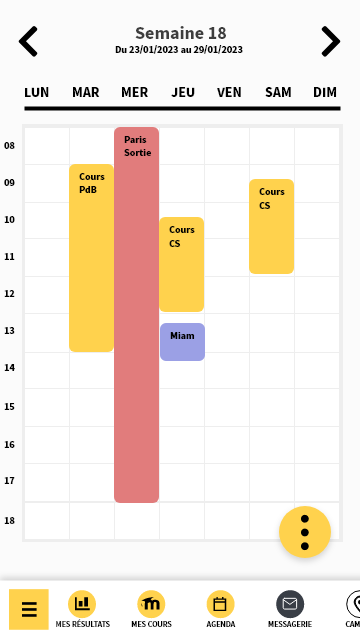
Timetable and schedule changes, with room-switch notifications
News feed
Exam results and grades
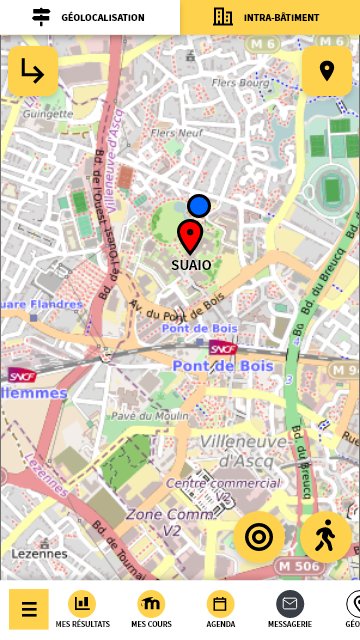
Custom-built geolocation for campus buildings
CROUS cafeteria menus
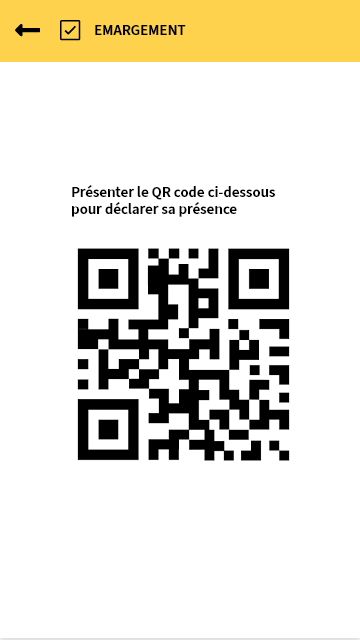
QR-code based attendance check-in
Design & development
Built with a clean, scalable UI using ULK tokens and spacing rules, designed for quick navigation and low cognitive load. Color use follows accessible contrast rules even at mobile scale, and typography was specifically optimised for small-screen readability.
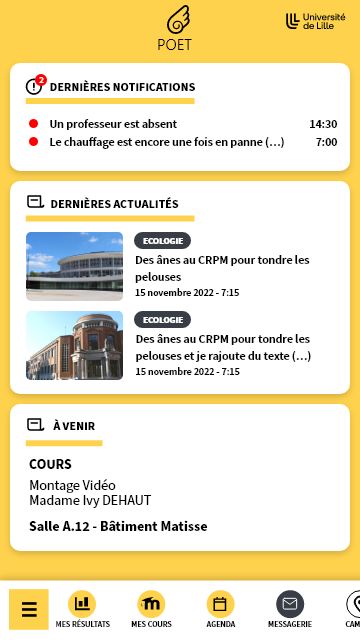
Home screen: personalised dashboard for the student.
Key screens
Outcome
The app is actively used by students and regularly updated. Feedback has been particularly positive on the QR-code check-in and the clarity of the schedule view. The project also served as an early proof of concept for using ULK tokens in a native mobile context, ahead of the system's later development.